Retirement Plan Role for Self-Employed Workers in 2026
A retirement plan for the self-employed is a tax-advantaged savings vehicle that builds long-term wealth while reducing your current taxable income, filling the gap left by the absence of any employer-sponsored plan. The role of retirement plan self employed workers must play is both financial and strategic: you are simultaneously the employee saving for the future and the employer funding that future. Without a structured plan, you are leaving serious tax savings on the table every single year. Options like the SEP IRA, solo 401(k), SIMPLE IRA, and defined benefit plan each serve different business profiles, and retirement plans are critical financial tools that must be treated as core business expenses, not afterthoughts. The median retirement savings for Americans aged 55 to 64 is only $30,000, a figure that underscores how badly most people underestimate the urgency of starting early.
What are the main retirement plan options for self-employed individuals?
Self-employed retirement options fall into four primary categories, each with distinct rules, limits, and ideal use cases. Choosing the wrong one does not just cost you flexibility. It can cost you thousands in avoidable taxes.
SEP IRA
The Simplified Employee Pension IRA is the easiest plan to open and maintain. You contribute as the employer only, up to 25% of net self-employment income, and SEP IRA contributions are made solely by the employer with no employee contributions allowed. The simplicity is real, but there is a catch: if you have employees, you must contribute the same percentage of compensation for every eligible worker. That obligation can make the SEP IRA expensive fast once you start hiring.
Solo 401(k)
The solo 401(k), also called an individual 401(k), is the most powerful option for a self-employed person with no full-time employees other than a spouse. You contribute as both employer and employee, which is the structural advantage that sets it apart. It also offers a Roth contribution option, loan provisions, and the highest possible contribution ceiling. Fidelity offers the Fidelity Advantage 401(k)℠ as a low-cost version specifically designed for small business owners who want institutional-grade features without high administrative overhead.

SIMPLE IRA
The Savings Incentive Match Plan for Employees IRA suits self-employed individuals who have a small team and want a straightforward plan with mandatory employer contributions. Contribution limits are lower than a solo 401(k), but the setup and compliance burden is lighter than a full 401(k). It is a reasonable middle ground for freelancers who have moved from solo work to running a small operation.
Traditional and Roth IRAs
Traditional and Roth IRAs are not exclusive to the self-employed, but they complement the plans above. The 2026 contribution limit is $7,000 per year ($8,000 if you are 50 or older). A Roth IRA is funded with after-tax dollars and grows tax-free, making it a strong pairing with a pre-tax SEP IRA or solo 401(k) for tax diversification.
Defined benefit plans
Defined benefit plans allow high-income self-employed individuals to shelter six-figure amounts annually, but they require strict annual funding regardless of income fluctuations and carry significant administrative costs. They work best for established solo practitioners, such as physicians or attorneys, with consistently high earnings and a shorter runway to retirement.
| Plan | 2026 Contribution Limit | Best For | Key Limitation |
|---|---|---|---|
| SEP IRA | Up to 25% of net income / $72,000 | Solo operators, simple setup | Equal % required for all employees |
| Solo 401(k) | Up to $72,000 (+ catch-up) | Solo or spouse-only businesses | Cannot have full-time employees |
| SIMPLE IRA | $16,500 employee / employer match | Small teams | Lower limits, mandatory match |
| Traditional/Roth IRA | $7,000 ($8,000 age 50+) | Supplemental savings | Low limit relative to income |
| Defined Benefit | Six figures possible | High earners near retirement | High admin cost, rigid funding |
Pro Tip: If you are unsure which plan fits, open a SEP IRA this year while you evaluate. You can contribute up to the tax filing deadline, including extensions, making it the most forgiving option for late starters.
How do contribution limits and tax advantages work in 2026?
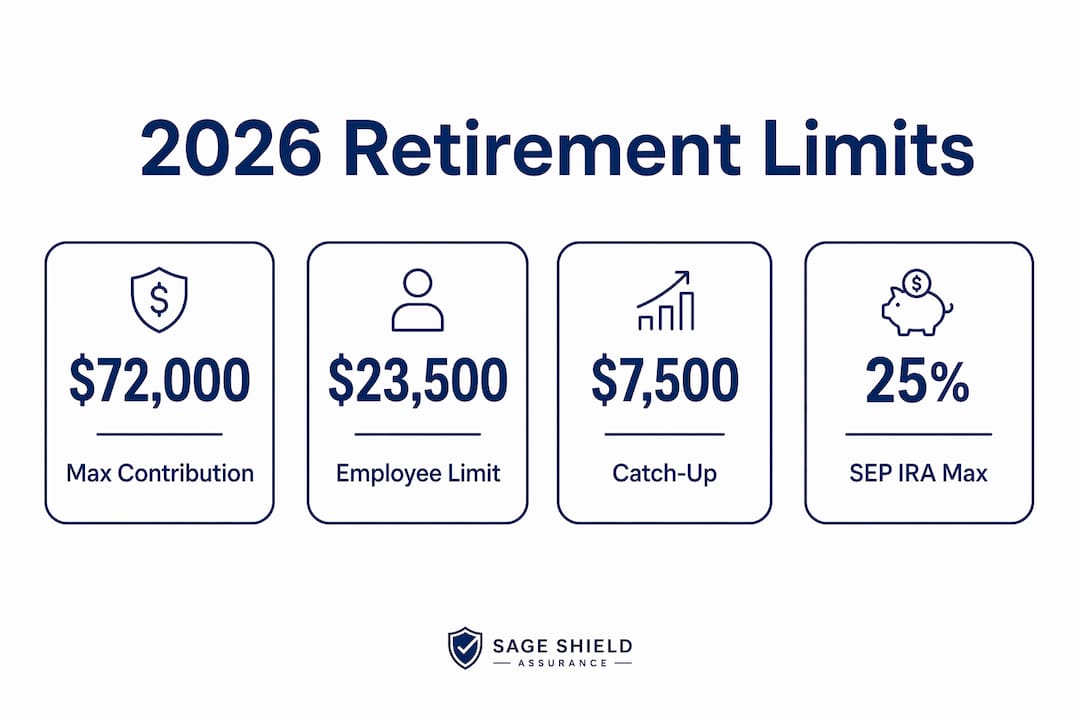
The numbers in 2026 make a compelling case for acting now. Self-employed individuals can contribute up to $72,000 annually to a solo 401(k) or SEP IRA, which is more than ten times the standard IRA limit of $7,000. That gap represents a massive tax deferral opportunity that salaried employees simply do not have access to.
In a solo 401(k), the dual-role structure is where the real leverage lives. As an employee, you can contribute up to $23,500 in 2026. As the employer, you can add up to 25% of net self-employment income on top of that. Failing to understand the employer versus employee contribution distinction is one of the most common ways self-employed individuals leave significant tax advantages untapped.
Catch-up contributions add another layer for those 50 and older. Solo 401(k) participants aged 50 or above can contribute an additional $7,500 in 2026, pushing the total ceiling even higher. This provision exists precisely because many self-employed workers spend their 30s and 40s reinvesting in their businesses rather than saving aggressively.
| Contribution Type | 2026 Limit | Who It Applies To |
|---|---|---|
| Solo 401(k) employee contribution | $23,500 | Self-employed under 50 |
| Solo 401(k) catch-up (age 50+) | Additional $7,500 | Self-employed age 50 and older |
| Total solo 401(k) / SEP IRA ceiling | $72,000 | All eligible self-employed |
| Traditional / Roth IRA | $7,000 ($8,000 age 50+) | All earners with earned income |
The tax treatment depends on which account type you choose. Pre-tax contributions to a SEP IRA or traditional solo 401(k) reduce your taxable income dollar for dollar this year. Roth contributions do not reduce current taxes but grow tax-free and create no tax liability at withdrawal. Mixing pre-tax and Roth accounts creates tax diversification, protecting you against future tax rate increases that no one can predict today.
Pro Tip: If your business had a strong year, maximize your employer contribution to a solo 401(k) before December 31. The employee contribution can be made up to the tax filing deadline, but the plan itself must be established by December 31 of the tax year.
What practical factors should you consider when choosing a plan?
Retirement planning for freelancers and solo operators is not one-size-fits-all. The right plan depends on your business structure, income consistency, hiring plans, and tolerance for administrative work. Here are the factors that matter most.
-
Employee headcount. A solo 401(k) closes the moment you hire a full-time employee who is not your spouse. If you plan to grow a team, a SEP IRA or SIMPLE IRA is a more sustainable foundation. Remember that SEP IRA rules require equal percentage contributions for all eligible employees, which can significantly raise your cost of hiring.
-
Income variability. Freelancers with uneven cash flow benefit from plans that allow flexible contribution amounts. SEP IRAs and solo 401(k)s let you contribute nothing in a lean year and maximize in a strong one. SIMPLE IRAs and defined benefit plans impose mandatory contribution schedules that can strain cash flow during slow periods.
-
Administrative complexity. SEP IRAs require almost no paperwork. Solo 401(k)s require an annual Form 5500-EZ filing once plan assets exceed $250,000. Defined benefit plans involve high administrative costs and actuarial calculations, making them practical only for high earners who can justify the overhead.
-
Automation as a discipline tool. Automating retirement contributions helps self-employed individuals overcome the temptation to prioritize short-term liquidity over long-term security. Setting up automatic monthly transfers to your retirement account removes the decision from your monthly budget review entirely.
-
Tax diversification across account types. Holding both a pre-tax solo 401(k) and a Roth IRA gives you flexibility in retirement to draw from whichever account minimizes your tax bill in any given year. Pairing a high-deductible health plan with a Health Savings Account adds a third tax-advantaged bucket. The HDHP and HSA combination is one of the most underused tax strategies available to self-employed workers.
How can you maximize retirement savings and tax benefits as a self-employed worker?
The best retirement plan for self employed workers is only as good as the strategy behind it. Knowing your options is step one. Executing consistently is what actually builds wealth.
-
Set a savings rate target first. Experts recommend that self-employed workers save 10% to 15% of pre-tax income annually. That benchmark gives you a concrete number to work toward rather than contributing whatever is left over at year end.
-
Increase contributions after business growth. Automating contribution increases tied to revenue milestones or annual raises accelerates fund growth while minimizing the psychological impact of saving more. If your business revenue grows 20% in a year, direct at least half of that increase toward retirement before it gets absorbed into expenses.
-
Use multiple account types strategically. A solo 401(k) for pre-tax contributions, a Roth IRA for after-tax growth, and an HSA for healthcare costs create three distinct tax buckets. Each one serves a different purpose in retirement income planning.
-
Maximize catch-up contributions at 50. The additional $7,500 catch-up allowance in a solo 401(k) is not just a number. For someone earning $150,000 annually, contributing that extra amount for ten years at a 7% average return adds roughly $100,000 to the final balance.
-
Review your plan annually. Business conditions change. A plan that fit a solo freelancer at $80,000 in revenue may be the wrong tool at $300,000. Reviewing your plan each year against your current income, employee count, and tax situation keeps your strategy aligned with reality.
Pro Tip: In a high-revenue year, consider making both a maximum solo 401(k) contribution and a backdoor Roth IRA contribution. The two accounts together give you both an immediate tax deduction and long-term tax-free growth.
Key takeaways
Self-employed individuals who treat retirement savings as a non-negotiable business expense, choose the right plan structure, and automate contributions will build substantially more wealth than those who treat it as optional.
| Point | Details |
|---|---|
| Role of retirement plans | Retirement plans reduce taxable income now and build financial security for the future. |
| Top plan options | Solo 401(k) and SEP IRA offer the highest 2026 limits at $72,000 total. |
| Tax diversification | Mixing pre-tax and Roth accounts protects against unpredictable future tax rates. |
| Automation matters | Automating contributions removes behavioral barriers and builds consistency over time. |
| Annual plan review | Revisit your plan each year as income, team size, and tax goals evolve. |
Why I think most self-employed workers are getting this badly wrong
After working with hundreds of self-employed professionals across dozens of industries, the pattern I see most often is not ignorance. It is delay. People understand that retirement savings matter. They just keep treating it as something to start “next year” once the business is more stable.
The uncomfortable reality is that stability never arrives on its own schedule. The freelancer waiting for a consistent income to start saving is the same person at 58 with $30,000 in savings wondering where the time went. That $30,000 median figure is not a statistic about other people. It describes the actual outcome of treating retirement as optional.
What I have found actually works is reframing the contribution as a business operating cost, not a personal finance decision. When you pay your software subscriptions and your accountant without hesitation, you should pay your future self with the same discipline. The tax deduction makes it even more rational: a $20,000 SEP IRA contribution at a 32% marginal rate costs you roughly $13,600 out of pocket. That is a 32% instant return before any investment growth.
The other mistake I see constantly is ignoring the employer contribution side of a solo 401(k). Most people contribute the employee portion and stop there, leaving the employer match on the table because they did not realize they could make both. That misunderstanding alone can cost tens of thousands in tax-deferred growth over a career.
Start now. Pick the simplest plan that fits your situation today. Automate it. Review it every January. The complexity can come later. The habit has to come first.
— mkaravas1m
Protect your financial future beyond just retirement
Retirement savings are one pillar of financial security for self-employed workers. Health coverage and life insurance are the others, and gaps in either can drain a retirement account faster than a bad market year.

Sageshieldassurance works with self-employed individuals and business owners across 40 states to find health and life insurance coverage that fits both their budget and their business structure. Whether you are a solo freelancer or running a small team, the right health insurance plan protects the income and assets your retirement plan is designed to grow. Sageshieldassurance also offers guidance on reducing insurance costs so your coverage does not compete with your savings goals. Talk to a Sageshieldassurance advisor to build a financial protection strategy that covers all the bases.
FAQ
What is the best retirement plan for self-employed individuals?
The solo 401(k) offers the highest contribution limits and the most flexibility for self-employed workers with no full-time employees, making it the top choice for most high earners. The SEP IRA is the better option for simplicity or if you have eligible employees.
How much can a self-employed person contribute to retirement in 2026?
Self-employed individuals can contribute up to $72,000 to a solo 401(k) or SEP IRA in 2026, with an additional $7,500 catch-up contribution available for those aged 50 and older.
Are self-employed retirement contributions tax deductible?
Yes. Contributions to a SEP IRA, traditional solo 401(k), or SIMPLE IRA reduce your taxable income in the year they are made, providing an immediate tax benefit in addition to long-term savings growth.
Can I have both a solo 401(k) and a Roth IRA?
Yes, and holding both is a strong tax diversification strategy. The solo 401(k) provides pre-tax deductions now, while the Roth IRA grows tax-free and creates no taxable income at withdrawal in retirement.
What happens to my SEP IRA if I hire employees?
Once you hire eligible employees, SEP IRA rules require you to contribute the same percentage of compensation for each eligible worker as you contribute for yourself, which can significantly increase your total contribution obligation.
Leave a Reply