What Is HIPAA Coverage Protection? Your Rights Explained
Most people assume HIPAA protects all their health information from everyone. That assumption is wrong, and it costs people real control over their own medical records. What is HIPAA coverage protection, exactly? It is a federal framework that restricts how specific types of organizations handle your health data. It does not apply to your employer, your gym, or your fitness app. Understanding who it covers, what it protects, and what rights it gives you is the difference between knowing your options and being caught off guard when something goes wrong.
Table of Contents
- Key Takeaways
- What HIPAA covers and who it applies to
- The core HIPAA rules that protect your health information
- Your practical rights under HIPAA coverage protection
- Common misconceptions about HIPAA coverage protection
- My perspective on HIPAA coverage protection in practice
- How Sageshieldassurance can help protect your health security
- FAQ
Key Takeaways
| Point | Details |
|---|---|
| HIPAA protects specific health data | Only Protected Health Information held by covered entities falls under HIPAA’s rules. |
| Not every organization is covered | Employers, life insurers, and wellness apps are generally not HIPAA covered entities. |
| You have real access rights | You can request, review, and correct your health records held by covered entities. |
| Breaches must be reported fast | Covered entities must notify you within 60 days of an unauthorized disclosure of your PHI. |
| HIPAA compliance is ongoing | Organizations must conduct regular audits and training, not just a one-time setup. |
What HIPAA covers and who it applies to
HIPAA, the Health Insurance Portability and Accountability Act, was signed into law in 1996. Its coverage protection provisions center on one core concept: Protected Health Information, or PHI. PHI covers any health data that can identify you and relates to your past, present, or future physical or mental health condition, the care you received, or payment for that care. It applies in electronic, paper, and oral form.
What counts as PHI
PHI includes a broader range of identifiers than most people realize. Your name paired with a diagnosis, your Social Security number on a billing form, your prescription history, your appointment dates, even your IP address when linked to health data can all qualify as PHI. The key is identifiability. Strip out all 18 categories of identifying information defined by HIPAA, and the data becomes “de-identified” and falls outside HIPAA’s scope.
Who qualifies as a covered entity
Covered entities include three groups: healthcare providers who conduct electronic transactions (think hospitals, doctors, dentists, and pharmacies), health plans (including employer-sponsored group health plans, Medicare, and Medicaid), and healthcare clearinghouses that process health data between providers and payers.
Here is where most people get tripped up:
- Your employer is not a covered entity in its employment capacity, even if it sponsors your health plan
- Life insurance companies that do not conduct HIPAA-covered transactions are not covered entities
- Fitness apps, wellness platforms, and direct-to-consumer genetic testing companies are not covered entities
- Workers’ compensation carriers and many school health records fall outside HIPAA’s reach
Business associates also carry HIPAA obligations. These are third parties that handle PHI on behalf of covered entities, such as billing companies, cloud storage vendors, and IT support firms. They must sign Business Associate Agreements and follow HIPAA’s rules directly.
Pro Tip: If you share health data with an app or wearable device, check whether it is a covered entity or a business associate. If it is neither, HIPAA does not protect that data. Read the platform’s own privacy policy instead.
The core HIPAA rules that protect your health information
HIPAA’s coverage protection framework rests on three major rules. Each one addresses a different layer of risk to your health information.
The Privacy Rule
The Privacy Rule sets the foundation for hipaa patient protection. It defines what PHI is, who can access it, and under what conditions covered entities can share it. Patients receive specific rights under this rule, including the right to access their records, request corrections, receive an accounting of disclosures, and ask for restrictions on certain uses of their data.
One of the most practical provisions is the Minimum Necessary standard. Covered entities must make reasonable efforts to use or disclose only the minimum amount of PHI needed to accomplish a given purpose. A billing department does not need your full psychiatric history to process a claim for a routine checkup. Failure to follow this standard can result in Privacy Rule violations and enforcement actions.
The Security Rule
The Security Rule applies specifically to electronic PHI, or ePHI. It requires covered entities to implement administrative, physical, and technical safeguards. Administrative safeguards include documented policies and staff training. Physical safeguards cover things like locked server rooms. Technical safeguards include encryption and access controls.

Here is a fact that underscores why this matters: medical data is worth three times as much as financial data on the black market. That makes healthcare organizations high-value targets, and the Security Rule exists to force them to take that threat seriously.
The Breach Notification Rule
When PHI is compromised, covered entities cannot stay quiet. The Breach Notification Rule requires them to:
- Notify affected individuals within 60 days of discovering a breach
- Report breaches affecting 500 or more individuals to the Department of Health and Human Services (HHS) and local media
- Submit annual reports to HHS for smaller breaches affecting fewer than 500 individuals
- Document all breach incidents and their outcomes
The scale of the problem makes this rule critical. In 2024, over 275 million patient records were compromised in more than 700 large-scale breaches. That is not a fringe risk. It is a systemic one.
“HIPAA violations carry penalties ranging from $145 to over $2.19 million per violation, with criminal charges possible in severe cases. A 2026 enforcement action resulted in a $245,000 settlement for a single group health plan’s noncompliance.” (source)
Your practical rights under HIPAA coverage protection
Understanding HIPAA coverage protection is not just about knowing the rules on paper. It is about knowing what you can actually do with those rights.
Accessing and controlling your PHI
You have the right to request a copy of your medical records from any covered entity that holds them. Covered entities generally must respond within 30 days. They can charge a reasonable fee for copies but cannot deny access simply because you owe them money for services.
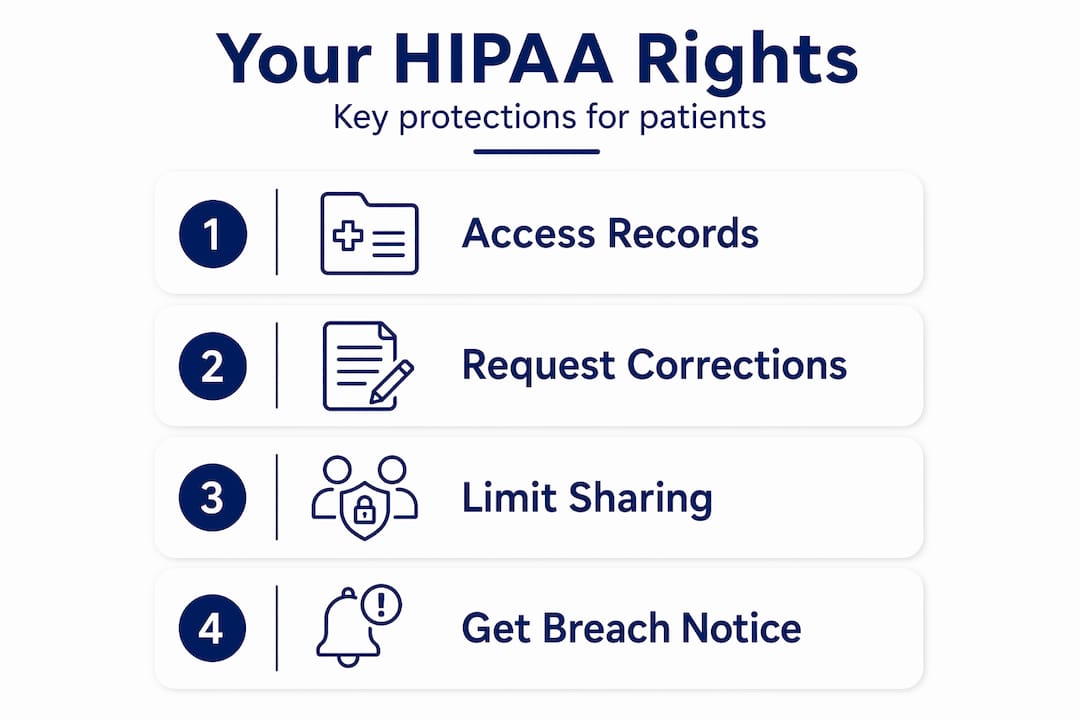
However, access can be denied in limited circumstances. Psychotherapy notes, information compiled for legal proceedings, and certain research data can be withheld. If you are denied, you have the right to request a review of that decision by a licensed professional designated by the covered entity.
Recognizing and reporting misuse
If you believe your PHI has been misused or improperly disclosed, you can file a complaint with HHS’s Office for Civil Rights (OCR). You can also file a complaint directly with the covered entity. Retaliation against you for filing a complaint is prohibited under HIPAA.
Here are practical steps to protect your own health information:
- Review the Notice of Privacy Practices you receive from healthcare providers. It explains how your data is used.
- Ask your provider what third parties have access to your records and under what conditions.
- Request an accounting of disclosures if you suspect your records were shared without your knowledge.
- Keep copies of your own medical records so you can spot errors or unauthorized changes.
Pro Tip: You can authorize the release of your PHI in writing for specific purposes, such as sharing records with a specialist. That authorization must specify what is being shared, with whom, and for how long. Read it carefully before signing.
How state laws interact with HIPAA
HIPAA sets a federal floor, not a ceiling. HIPAA does not preempt more stringent state privacy laws. If your state has stronger protections for mental health records, HIV status, or reproductive health data, covered entities operating in that state must comply with both the federal HIPAA rules and the stricter state rules. This matters practically because your rights may be stronger than the federal baseline depending on where you live.
Common misconceptions about HIPAA coverage protection
A lot of confusion about HIPAA stems from overstating what it does. Here is a clear comparison of what HIPAA actually covers versus what people commonly assume.
| Common assumption | What HIPAA actually says |
|---|---|
| HIPAA protects all health data everywhere | HIPAA only applies to PHI held by covered entities and their business associates |
| Your employer cannot see your health records | Employers are not covered entities; HIPAA does not restrict what they do with data they collect directly |
| HIPAA means your data is completely private | Covered entities can share PHI for treatment, payment, and healthcare operations without your consent |
| HIPAA compliance is achieved once and maintained | Compliance is ongoing, requiring regular audits, training, and policy updates |
| You can always access any part of your records | Some records, like psychotherapy notes, can be legally withheld |
One misconception worth addressing directly: HIPAA does not prohibit covered entities from sharing your information for treatment purposes. Your primary care doctor can share your records with a specialist without asking your permission first. That is by design. The goal is coordinated care, not information lockdown.
Another point that surprises people: employer-sponsored health plans are covered entities, but the employer in its HR capacity is not. If your company’s HR department accesses your health plan data improperly, HIPAA may still apply through the plan itself. The lines are real but nuanced.
Heightened regulatory scrutiny in 2025 and 2026 has pushed organizations toward continuous HIPAA program management rather than episodic compliance reviews. That shift is good for patients. It means more consistent protection rather than scrambling to fix problems only when audits happen.
My perspective on HIPAA coverage protection in practice
I have spent years working with self-employed individuals and small business owners navigating health coverage decisions, and one thing I see consistently is that people dramatically overestimate how much HIPAA actually shields them. They assume the law is working in the background protecting everything. In reality, HIPAA is more like a targeted rule set with real gaps.
What I have found is that the individuals who fare best are the ones who treat HIPAA as a starting point, not a guarantee. They read their Notice of Privacy Practices. They ask questions when they sign authorizations. They know which of their health data lives outside the HIPAA umbrella entirely, like the information they share with wellness apps or direct-to-consumer testing services.
The other thing I want to push back on is the idea that HIPAA compliance is the covered entity’s problem alone. Yes, risk analysis is a fiduciary duty for employer-sponsored group health plans. Yes, organizations face real penalties for getting it wrong. But you, as the individual whose data is at stake, have more leverage than you probably use. File complaints. Request your records. Know your state’s laws. The system works better when patients are engaged participants, not passive recipients.
The digital health era has made this more urgent, not less. More of your health data is moving through more systems than ever before. Understanding HIPAA coverage protection is not just reassuring. It is the first step toward doing something about it.
— mkaravas1m
How Sageshieldassurance can help protect your health security
HIPAA gives you rights over your health information. But rights alone do not pay medical bills or protect your income if a serious diagnosis forces you off work. That is where the right health insurance coverage becomes the practical partner to HIPAA’s legal protections.
At Sageshieldassurance, we work specifically with self-employed individuals and small business owners who need private health coverage that actually fits their situation. If you are running your own business, you do not have an HR department managing your benefits. You need a plan that covers you properly and a brokerage that explains your options without the corporate runaround. Explore what private health insurance options look like for business owners and self-employed individuals, or browse our health insurance plans to find coverage that fits your needs. HIPAA protects your data. The right insurance protects your health and your financial stability.
FAQ
What is HIPAA coverage protection in simple terms?
HIPAA coverage protection refers to the federal rules that restrict how healthcare providers, health plans, and clearinghouses handle your Protected Health Information. It gives you rights to access, correct, and control how your health data is used and shared.
Does HIPAA apply to my employer?
Your employer is generally not a HIPAA covered entity in its employment capacity. However, if your employer sponsors a group health plan, that plan itself is a covered entity and must follow HIPAA rules when handling your PHI.
What happens if a covered entity breaches my health information?
Covered entities must notify you within 60 days of discovering a breach. Large breaches affecting 500 or more individuals must also be reported to HHS and local media. You can file a complaint with HHS’s Office for Civil Rights if you believe your PHI was mishandled.
Can I always access my own medical records under HIPAA?
You have a strong right to access your records, but there are exceptions. Psychotherapy notes and information compiled for legal proceedings can be withheld. If access is denied, you have the right to request a formal review of that decision.
Is HIPAA compliance a one-time requirement for organizations?
No. HIPAA compliance is a continuous obligation. Covered entities must conduct regular risk analyses, update policies, and train staff on an ongoing basis. A single security assessment does not satisfy the requirement.
Leave a Reply