What Is Business Life Insurance for Small Business Owners
Business life insurance is defined as life insurance structured to protect a company’s financial stability, cover business debts, and fund ownership succession rather than solely providing for an owner’s personal family. Most self-employed individuals and small business owners treat their personal policy as a catch-all solution. That assumption creates dangerous gaps. The three most common forms, key person insurance, buy-sell agreement funding, and group term life coverage, each serve a distinct financial purpose that personal policies cannot replicate. Sources like NerdWallet, Mutual of Omaha, and Western Southern have documented these structures extensively, and understanding them is the first step toward protecting what you have built.
What types of business life insurance are available?
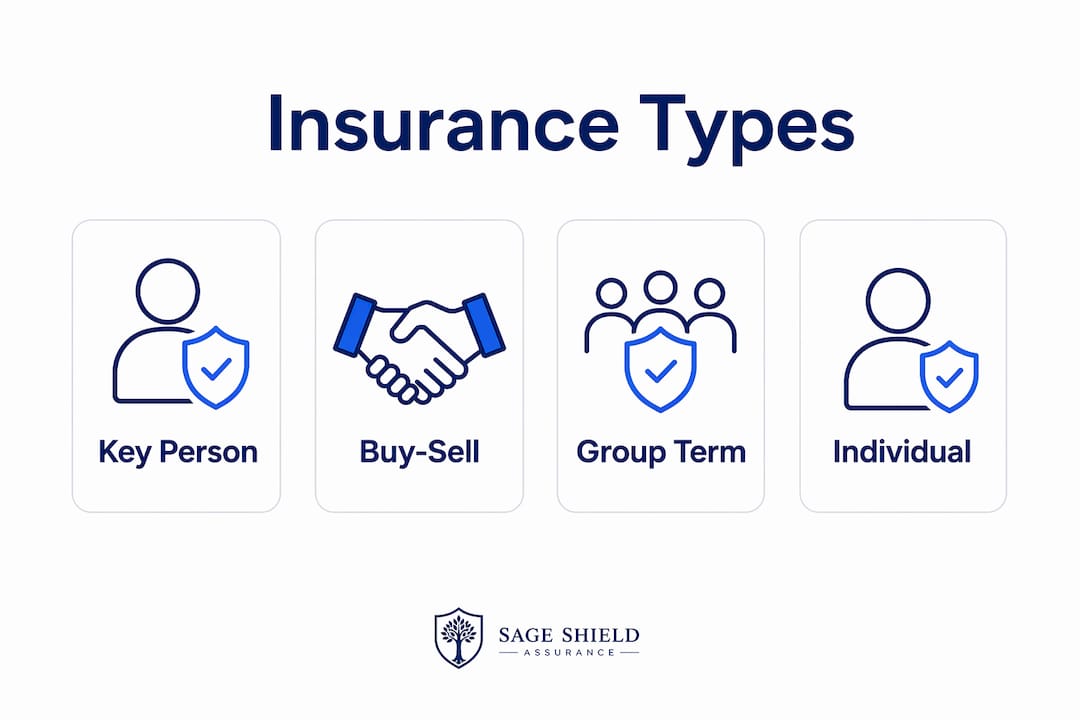
Business life insurance covers four primary policy structures, each designed for a different financial risk a business faces.
Key person insurance
Key person insurance is a policy the business owns and pays for, with the business named as the beneficiary. If a critical owner or employee dies, the death benefit goes to the company to cover lost revenue, recruiting costs, and operational disruption. A software firm that loses its sole developer, or a dental practice that loses its lead dentist, faces an immediate cash flow crisis. Key person coverage turns that crisis into a manageable transition.

Buy-sell agreement funding
A buy-sell agreement is a legal contract that defines what happens to ownership when a partner dies or becomes disabled. Life insurance funds that agreement by providing the surviving owners with liquidity to buy out the deceased partner’s share. Without this funding, surviving partners may be forced to sell assets, take on debt, or negotiate with the deceased’s heirs under pressure. The policy converts a potentially chaotic ownership transfer into an orderly transaction.
Group term life insurance
Employers offer group term life insurance as a benefit to employees. The IRS allows the first $50,000 of coverage to be excluded from an employee’s taxable income under Section 79. Coverage above that threshold becomes taxable imputed income. The U.S. group term life market carried $32.8 billion in premiums in 2025, which signals how widely businesses use this benefit to attract and retain talent.
Individual policies used for business purposes
Some business owners purchase individual term or permanent life policies and structure them to serve business goals. Term policies are lower cost and work well for covering a specific business loan or a defined partnership period. Permanent policies, such as whole life or universal life, build cash value that a business can borrow against for capital needs.
| Policy Type | Who Owns It | Who Benefits | Best Use Case |
|---|---|---|---|
| Key person insurance | The business | The business | Replacing a critical employee or owner |
| Buy-sell agreement funding | Each partner or the business | Surviving owners | Funding ownership transfer at death |
| Group term life | The employer | Employees’ beneficiaries | Employee retention and benefits package |
| Individual policy for business | The owner | Business or family | Loan coverage, capital access, succession |
Pro Tip: Structure the policy ownership before you apply. Changing ownership after a policy is issued can trigger gift taxes and complicate the insurable interest requirement.
What are the real financial benefits of business life insurance?
The most direct benefit is preventing a liquidity crisis after the death of a key person. Without cash on hand, a business may be forced to sell equipment, real estate, or client contracts at a fraction of their value. Life insurance eliminates that pressure by delivering a lump sum exactly when it is needed most.
Beyond cash flow, the benefits break down into four categories:
- Debt coverage. Many small business loans require a personal guarantee. If the owner dies, that debt does not disappear. A life insurance payout can retire the loan before it becomes the family’s problem.
- Succession funding. Buy-sell agreements funded by life insurance give surviving partners the money to buy out a deceased owner’s share at a pre-agreed valuation, protecting both the business and the deceased’s heirs.
- Talent continuity. Key person proceeds can fund a search for a replacement, cover training costs, and compensate for reduced productivity during the transition period.
- Family financial security. For a sole proprietor, the business and personal finances are deeply intertwined. A policy that covers business debts protects the family from inheriting liabilities alongside assets.
Tax considerations matter here. Premiums paid by the business for key person or buy-sell policies are generally not tax-deductible when the business is the beneficiary. However, the death benefit is typically received income-tax-free by the business. Group life premiums paid for employees are deductible as a business expense, which makes them a cost-effective benefit.
Pro Tip: Talk to a CPA before structuring any business life policy. The deductibility rules differ significantly depending on who owns the policy and who receives the benefit.
How do you choose and structure the right policy?
Choosing the right business life insurance policy starts with mapping your actual financial exposure, not guessing at a round number. Work through these steps in order:
- Quantify your financial risks. List outstanding business loans, annual payroll, projected revenue for the next two to three years, and the estimated cost to recruit and train a replacement for each key person.
- Align ownership with the entity suffering the loss. If the business suffers the financial loss, the business should own the policy and be the beneficiary. If the surviving partners suffer the loss, each partner may own a policy on the other.
- Match the policy type to your timeline. A 10-year term policy works for a specific loan. A permanent policy works better for long-term succession planning where cash value accumulation adds strategic value.
- Draft or update your buy-sell agreement alongside the policy. The legal document and the insurance must align on valuation method, triggering events, and payout timing. A policy that pays out $1 million while the agreement values the share at $1.4 million creates a shortfall at the worst possible moment.
- Review annually or after any major business change. A new partner, a significant loan, or a major revenue increase all change your coverage needs. Policies that made sense three years ago may be dangerously underweight today.
Working with a business attorney and an insurance advisor together, rather than separately, prevents the misalignment that makes buy-sell agreements fail in practice. The self-employed insurance guide from Sageshieldassurance walks through this coordination process in detail.
What are the most common misconceptions about business life insurance?
The most persistent misconception is that a personal life insurance policy covers business risks adequately. It does not. Business continuity planning consistently reveals gaps where owners rely on personal coverage and leave key person and partnership risks completely uninsured. A personal policy pays your family. It does not pay your business partner, retire your business loan, or fund a replacement hire.
Several other misunderstandings cause real financial damage:
- Premiums are always deductible. False. When the business is the beneficiary of a key person or buy-sell policy, the IRS does not allow premium deductions. Only group life premiums paid for employees are generally deductible.
- Group life coverage is always tax-free. Partially true. The IRS Section 79 rules limit the tax exclusion to the first $50,000 of employer-paid group term coverage. Anything above that threshold is treated as taxable imputed income for the employee, and incorrect plan setup can trigger unexpected tax bills.
- Any life insurance policy works for a buy-sell agreement. Incorrect. The policy face amount must match the agreed business valuation, and the ownership structure must reflect the agreement’s terms. A mismatch between the two documents can leave surviving partners without enough funds to complete the buyout.
“The business owner who assumes their personal policy handles everything is the same owner whose family inherits a business they cannot run and debts they cannot pay.” This is the scenario that proper business life insurance is designed to prevent.
Insurable interest is another area where owners get into trouble. The business must have a documented financial interest in the insured person’s life to legally own the policy. For key employees who are not owners, this requires clear documentation of the financial dependency.
Key takeaways
Business life insurance protects your company’s cash flow, ownership structure, and financial continuity in ways that personal life insurance policies are not designed to address.
| Point | Details |
|---|---|
| Business vs. personal coverage | Personal policies protect families; business policies protect cash flow, debts, and ownership transitions. |
| Four main policy types | Key person, buy-sell funding, group term, and individual business-purpose policies each serve a distinct risk. |
| Tax rules are specific | Group term premiums are deductible; key person and buy-sell premiums are not when the business is the beneficiary. |
| Ownership structure matters | The entity that suffers the financial loss should own the policy and be named as beneficiary. |
| Annual reviews are required | Business changes like new partners or larger loans require policy updates to avoid dangerous coverage gaps. |
Why most small business owners get this wrong
I have worked with hundreds of self-employed individuals and small business owners on insurance planning, and the pattern is almost always the same. The owner has a solid personal life policy, maybe even a generous one, and genuinely believes the business is covered. The buy-sell agreement exists as a PDF in a folder nobody has opened in four years. The key person policy was purchased when the business had three employees and now has twelve.
The real problem is not ignorance. It is that business life insurance sits at the intersection of legal, financial, and insurance planning, and most owners handle each of those disciplines separately. The attorney drafts the buy-sell agreement without knowing the policy face amount. The insurance advisor sells the policy without reading the agreement. Nobody reconciles the two until a death forces the issue.
What actually works is treating the policy review and the legal document review as a single annual event. Bring your attorney, your CPA, and your insurance advisor into the same conversation once a year. The cost of that meeting is trivial compared to the cost of a misaligned buyout. I have also found that private health insurance for business owners planning often surfaces life insurance gaps that owners had not noticed, which makes it a useful starting point for the broader conversation.
The owners who handle this well are not necessarily the ones with the most coverage. They are the ones who review their coverage with the same discipline they apply to their quarterly financials.
— mkaravas1m
How Sageshieldassurance helps you get covered correctly
Sageshieldassurance works specifically with self-employed individuals and small business owners who need life insurance structured for business purposes, not just personal protection. Their team reviews your business structure, outstanding liabilities, and partnership agreements before recommending any policy.

With partnerships across leading carriers and clients in 40 states, Sageshieldassurance matches your coverage to your actual financial exposure rather than a generic face amount. Whether you need key person coverage, buy-sell funding, or a group term plan for your team, their advisors guide you through ownership structure, beneficiary designation, and tax implications from the start. Visit the business life insurance guide to see exactly what coverage options are available for your situation.
FAQ
What is business life insurance in simple terms?
Business life insurance is a life insurance policy structured to protect a company’s financial interests rather than solely a personal family. Common forms include key person insurance, buy-sell agreement funding, and employer-paid group term coverage.
Who needs business life insurance?
Any business owner with partners, key employees, outstanding business loans, or succession plans needs some form of business life insurance. Sole proprietors with business debt that could transfer to their family also benefit significantly.
Is business life insurance tax deductible?
It depends on the policy structure. Employer-paid group term life premiums are generally tax-deductible as a business expense. Premiums for key person or buy-sell policies are not deductible when the business is the beneficiary, though the death benefit is typically received income-tax-free.
How does a buy-sell agreement use life insurance?
A buy-sell agreement defines ownership transfer terms at death or disability. Life insurance funds the agreement by providing surviving owners with cash to purchase the deceased partner’s share at the pre-agreed valuation, preventing forced asset sales or family disputes.
How much business life insurance do I need?
Coverage should reflect your actual financial exposure: outstanding business loans, annual payroll, projected revenue loss, and the cost to recruit and train a replacement for any key person. A flat number without this analysis almost always results in underinsurance.
Leave a Reply