Reduce Health Insurance Costs for Your Business in 2026
Reducing health insurance costs for your business is achievable right now, without dropping coverage or shrinking your network. The formal term for this approach is employer health benefits optimization, and it combines tax credits, plan design, and account-based tools to lower what you actually spend. Small businesses with fewer than 25 employees can cut premiums by up to 50% through the Small Business Health Care Tax Credit alone. Tools like the SHOP marketplace, Health Reimbursement Arrangements (HRAs), and Health Savings Accounts (HSAs) make this possible for even the smallest operations.
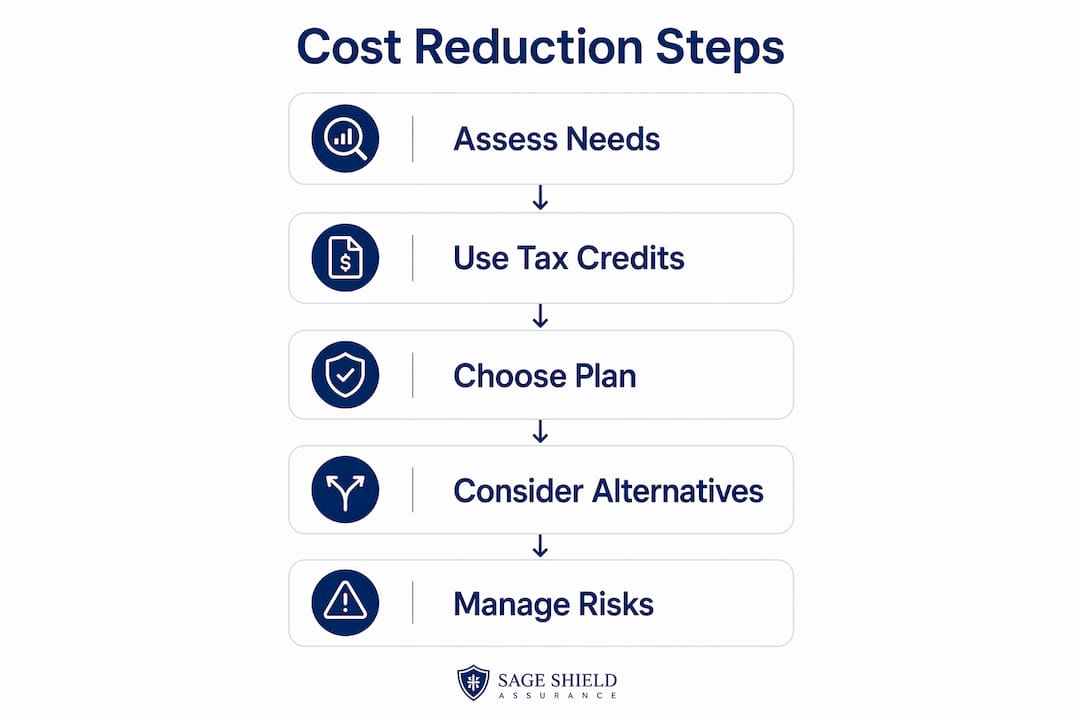
How to reduce health insurance costs for your business
The foundation of any cost-reduction strategy is understanding which tools are available and which ones apply to your situation. Three categories matter most: tax credits, plan structure, and account-based benefits.
Tax Credits and Marketplaces

The SHOP (Small Business Health Options Program) marketplace is the gateway to the Small Business Health Care Tax Credit. Eligibility requires fewer than 25 full-time equivalent employees and average wages under $62,000. The credit directly offsets your premium payments, making SHOP the most cost-effective starting point for qualifying employers.
Account-Based Benefits
Three account types reduce what you pay out of pocket:
- HRA (Health Reimbursement Arrangement): Employer-funded accounts that reimburse employees for medical expenses tax-free
- HSA (Health Savings Account): Employee-owned accounts paired with high-deductible health plans (HDHPs) that offer triple tax advantages
- QSEHRA (Qualified Small Employer HRA): Designed for businesses with no group plan, allowing fixed monthly reimbursements as low as $100 per employee
Plan Tier Comparison
| Plan Type | Avg. Monthly Premium | Best For |
|---|---|---|
| Platinum PPO | Highest | Low deductible preference |
| Gold PPO + GCHRA | Moderate | Employer cost control |
| HDHP + HSA | Lowest | Healthy, cost-conscious teams |
| ICHRA | Variable | Budget flexibility |
Choosing the right combination depends on your workforce size, health usage patterns, and budget. The table above is a starting framework, not a final answer.
How does the small business health care tax credit work?
The Small Business Health Care Tax Credit is the most direct way to lower health insurance premiums for qualifying employers. Businesses must purchase coverage through the SHOP marketplace and pay at least 50% of employee-only premiums to qualify. The credit reduces net premium costs by up to 50% for for-profit businesses and up to 35% for tax-exempt nonprofits.
Here is how to apply it step by step:
- Confirm eligibility: fewer than 25 FTE employees, average wages under $62,000
- Enroll in a SHOP marketplace plan through HealthCare.gov or a licensed broker
- Pay at least 50% of the employee-only premium
- Claim the credit on IRS Form 8941 when filing your business taxes
- Carry unused credit forward up to one year if it exceeds your tax liability
Pro Tip: If your average wages are close to $62,000, restructuring how you calculate full-time equivalents, for example by excluding owner wages, can bring you under the threshold and unlock the credit.
For businesses that do not qualify for SHOP, private market plans through carriers like Blue Cross Blue Shield, Aetna, or UnitedHealthcare may offer more plan variety. The tradeoff is losing the tax credit, so run the numbers before switching. You can also explore individual health coverage options if you are self-employed without employees.
What plan designs lower costs without cutting coverage?
The biggest misconception in employer health benefits is that cost reduction requires cutting benefits or shrinking networks. Modern plan design proves otherwise. The most effective approach pairs a lower-premium plan tier with an employer-funded Group Coverage HRA (GCHRA).
Here is the core example: switching from a Platinum PPO to a Gold PPO combined with a GCHRA can save employers about 12% on total health insurance costs while keeping the employee’s effective deductible at $0. The employer funds the HRA to cover the gap between the Gold plan’s deductible and what the Platinum plan would have covered. Employees feel no difference. You pocket the savings.
Why utilization rates matter:
- GCHRA funds are only spent when employees actually use them
- Utilization rates of 60–75% mean 25–40% of HRA funds revert to the employer
- A $500 per employee HRA budget may cost you only $300–$375 in actual payouts
- Unused funds do not roll over to employees, protecting your budget
Pro Tip: Effective GCHRA administration requires integrated payroll, benefits, and banking systems. Platforms like Rippling or Gusto that connect payroll and benefits in one place reduce manual errors and automate reimbursement claims.
Administering a GCHRA manually is where most small businesses stumble. Without automated claim processing, reimbursements get delayed and employees lose confidence in the benefit. Technology is not optional here. It is the mechanism that makes the savings real.
You can review health plan tier structures in detail to understand how Gold, Silver, and Bronze tiers affect your total cost exposure before committing to a plan change.
Do hdhps and hsas actually save money for small businesses?
High-deductible health plans are the most direct way to lower health insurance premiums. HDHPs typically cost 20–35% less in monthly premiums compared to traditional PPOs. That gap is significant for a business paying premiums for five, ten, or twenty employees.
The savings come with a tradeoff: employees face higher out-of-pocket costs before insurance kicks in. HSAs solve that problem. The IRS allows employees and employers to contribute pre-tax dollars to an HSA, which employees then use for deductibles, copayments, and coinsurance. The HSA tax advantage applies at contribution, growth, and withdrawal, making it the only triple-tax-advantaged account in the U.S. tax code.
Employer HSA contribution strategies:
- Seed the account with $500–$1,000 per employee per year as a tax-deductible benefit that reduces W-2 liability
- Match employee contributions dollar-for-dollar up to a set cap
- Front-load contributions at the start of the plan year to reduce employee anxiety about early medical expenses
- Communicate the HSA balance clearly so employees understand their actual cost exposure
The HDHP plus HSA combination works best for younger, healthier workforces. If your team skews older or has chronic conditions, the higher deductibles may generate more employee dissatisfaction than the premium savings justify. Know your workforce before committing.
What alternative arrangements help manage premium expenses?
Beyond SHOP and HDHPs, three alternative structures give small businesses more control over health spending.
Self-Funded Health Plans
A self-funded health plan means the employer pays claims directly instead of paying a fixed premium to a carrier. The upside is significant: you only pay for care your employees actually use. The risk is a catastrophic claim year. Most self-funded small businesses buy stop-loss insurance to cap their exposure. This structure works best for businesses with 20 or more employees and stable, predictable claim histories.
ICHRA: Individual Coverage HRA
The Individual Coverage HRA gives employers a defined monthly budget per employee. Employees buy their own individual plans on the marketplace, then submit receipts for reimbursement. The ICHRA provides flexible budget control with no minimum contribution requirement. You set the amount. Employees choose their own coverage. This is particularly useful for businesses with part-time or geographically dispersed teams where a single group plan is impractical.
| Structure | Best For | Key Advantage |
|---|---|---|
| Group Plan + GCHRA | 5–50 employees | Preserves group benefits feel |
| ICHRA | Remote or part-time teams | Full budget control |
| Self-Funded + Stop-Loss | 20+ employees, stable claims | Pay only for actual use |
| QSEHRA | Under 50, no group plan | Simple fixed reimbursement |
Bundling and Risk Management
Bundling policies, improving safety practices, and reviewing coverage regularly can reduce premiums across your entire insurance portfolio. Raising deductibles on ancillary lines like dental or vision while keeping medical deductibles low is one way to cut total spend without affecting the coverage employees value most. The ACA requires employer contributions to cover at least 50% of the employee-only premium, so factor that floor into any restructuring plan.
Key takeaways
The most effective way to reduce health insurance costs for your business is to combine tax credits, modern plan design, and account-based tools rather than simply cutting coverage.
| Point | Details |
|---|---|
| Use the SHOP tax credit first | Businesses with under 25 employees can cut net premiums by up to 50% through the Small Business Health Care Tax Credit. |
| Pair lower-tier plans with HRAs | Switching from Platinum to Gold PPO plus a GCHRA saves roughly 12% while keeping employee deductibles at $0. |
| HDHPs cut premiums 20–35% | Pairing an HDHP with employer-seeded HSA contributions offsets higher deductibles and delivers triple tax benefits. |
| ICHRA gives budget certainty | Fixed monthly reimbursements let you control spend without managing a group plan. |
| Administration technology is required | Integrated payroll and benefits platforms are necessary to run HRAs without errors or delays. |
What i’ve learned working with small business health plans
Most small business owners I talk to assume that lowering their health insurance bill means their employees will notice and complain. That assumption is wrong, and it costs them money every year.
The plan design strategies described above, specifically the GCHRA paired with a Gold PPO, are not theoretical. They work because employees measure their health plan by what they pay out of pocket, not by what tier the plan sits on. If the effective deductible stays at zero, the employee experience does not change. The employer captures the savings quietly.
Where I see businesses fail is on the administrative side. They set up an HRA, fund it, and then run reimbursements through a spreadsheet and a separate bank account. Claims get lost. Employees get frustrated. The benefit collapses. The fix is simple: use a platform that connects payroll and benefits. The technology cost is a fraction of the savings.
My other observation is that most business owners have never had a broker walk them through a side-by-side cost comparison of their current plan versus a GCHRA structure. They renew the same plan every year because switching feels complicated. Working with a broker who specializes in small business and self-employed coverage, rather than a generalist, changes that. The right broker runs the numbers, explains the tradeoffs, and handles the paperwork. That conversation alone is worth having.
— mkaravas1m
How Sageshieldassurance helps you cut coverage costs
Sageshieldassurance works specifically with self-employed individuals and small business owners who want to lower their health insurance spend without guessing which plan structure is right for them.

With partnerships across leading carriers and experience serving over 500 families in 40 states, Sageshieldassurance builds side-by-side comparisons of SHOP plans, GCHRA structures, ICHRA arrangements, and HDHP options tailored to your workforce size and budget. Their team handles the complexity so you do not have to. Explore your small business health insurance options or read more about cost reduction strategies for 2026 to see what your business could save this year.
FAQ
What is the fastest way to lower business health insurance premiums?
Qualifying businesses should apply for the Small Business Health Care Tax Credit through the SHOP marketplace first. It can reduce net premium costs by up to 50% with no plan changes required.
Can i offer health benefits without a group plan?
Yes. ICHRA and QSEHRA both allow employers to reimburse employees for individual market coverage without managing a group plan. QSEHRA allows fixed monthly reimbursements starting at $100 per employee.
Are HSA contributions tax-deductible for employers?
Employer contributions to employee HSAs are fully tax-deductible and reduce W-2 liability. Many employers contribute $500–$1,000 per employee per year as a cost-effective way to offset HDHP deductibles.
What is a GCHRA and how does it save money?
A Group Coverage HRA (GCHRA) is an employer-funded account that reimburses employees for out-of-pocket costs under a group plan. Pairing it with a Gold PPO instead of a Platinum PPO saves roughly 12% on total costs, with unused funds reverting to the employer.
Do self-funded plans work for very small businesses?
Self-funded plans work best for businesses with 20 or more employees and predictable claim histories. Smaller businesses typically need stop-loss insurance to cap catastrophic claim exposure, which adds cost and complexity.
Leave a Reply